



Key Takeaways
- Generational organization: Financially successful families use different family office structures to organize wealth, governance and decision-making across generations.
- Strategic trade-offs: The right structure depends on complexity, cost tolerance and desired level of control.
- Core pillars: Strong governance, integrated planning and clear succession are critical to preserving wealth and family harmony.
- Structural variety: Family offices can be structured as single-family offices, multifamily offices, virtual family offices or embedded family offices inside a broader wealth management firm, and each option has trade-offs for cost, complexity and control.
Creative Planning provides family office-style advisory and wealth management services to ultra-high-net-worth (UHNW) families, including those whose wealth spans multiple entities, asset classes and generations. This article is intended to provide educational information to help you explore the range of family office structures and options available. It’s not a recommendation for any specific structure or an offer to set up a family office entity.
Introduction to Family Office Structures
A family office is a dedicated structure that manages the financial, legal and personal affairs of a wealthy family, often coordinating everything from investment management and tax planning to philanthropy and family education. In practice, a family office structure is about organizing people, finances, processes and decision-making so that wealth and values can endure over multiple generations, rather than relying on ad hoc decisions from one or two individuals.
In the United States, family office structures have evolved to serve a wide range of affluent families, from a single wealthy family with a closely held family business to multiple families that share a common platform and specialist team. For many high-net-worth and ultra-high-net-worth families, a family office becomes the central hub for wealth management, family governance and long-term planning. The structure they choose shapes how decisions are made, which services are handled in-house versus outsourced, and how responsibilities are shared among family members and professional advisors.
For a broader look at how a coordinated team can support complex families, review Creative Planning’s overview of family office wealth management solutions, which describes our family office-style advisory approach for ultra-high-net-worth families.
Types of Family Office Structures
Family office structures exist on a spectrum, from fully dedicated entities for a single wealthy family to shared platforms that support multiple families. Understanding the main models can help you decide what fits your needs today and how your approach might evolve over time.
Single-family office
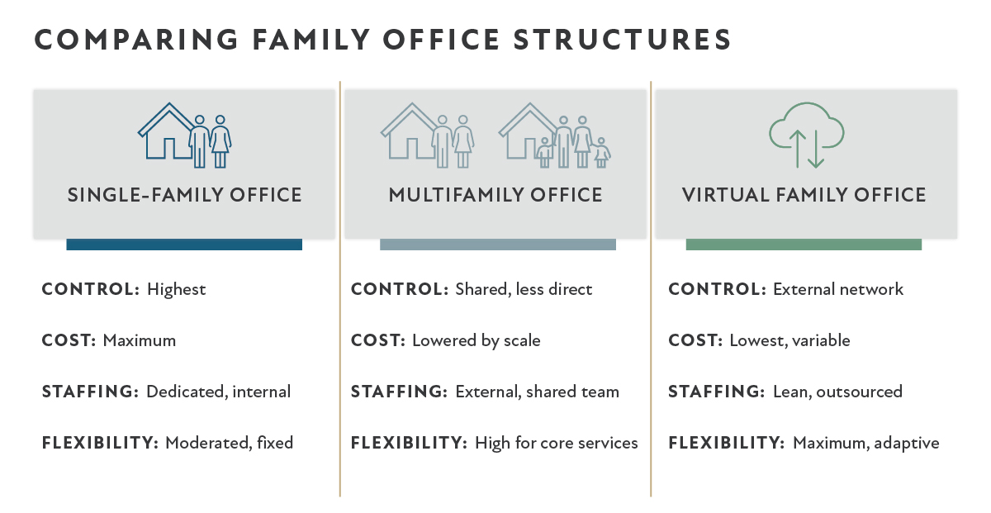
A single-family office is a standalone entity created to serve one wealthy family, often resembling a small private company with executive leadership and a team of specialists. This structure can provide a high degree of control, privacy and customization, with investment decisions, risk management, reporting, philanthropy and lifestyle services potentially managed under one roof.
Because the team is dedicated, a single-family office can deliver highly tailored work around investment management, tax planning, estate planning and next-generation education. The trade-off is cost and complexity, as the cost of running a single-family office typically starts at around $1 million per year and can rise significantly as scope expands. For more details on costs, staffing and setup steps, review Creative Planning’s guide to single-family office structure, costs and setup.
Multifamily office
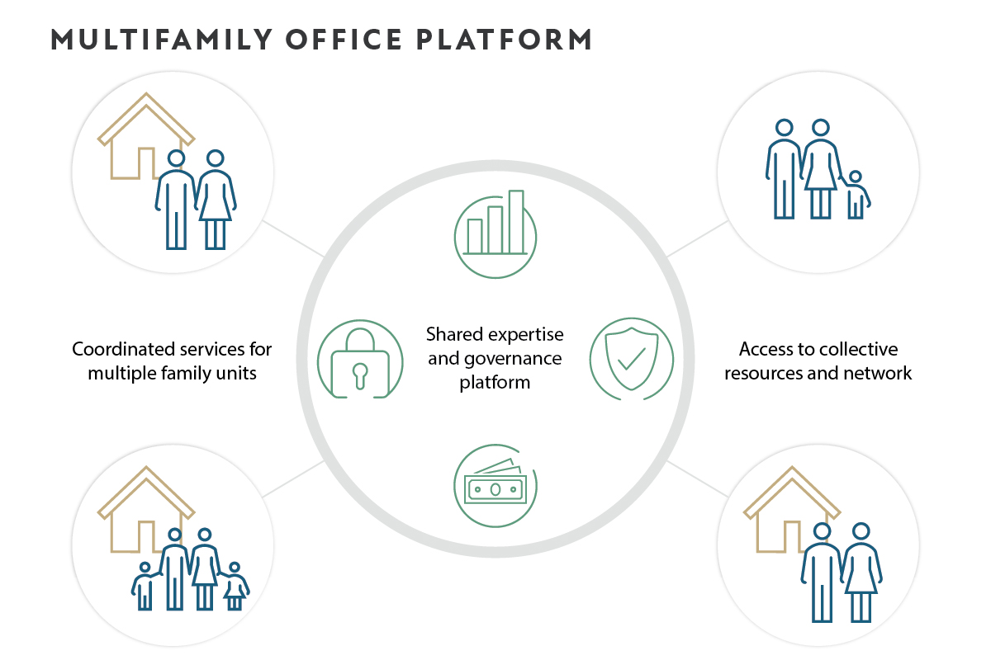
A multifamily office serves several families through a shared platform, allowing them to pool resources to access institutional-quality services. Investment management, tax and estate planning, family governance support and consolidated reporting are delivered by a coordinated team, with each family receiving a tailored — but not fully bespoke — experience.
This structure can be appealing for families who want comprehensive services and many of the same benefits as a single-family office but prefer a more efficient, lower-cost approach. Because a multifamily office spreads infrastructure and staffing costs across multiple families, it can make sophisticated family office services more accessible to an affluent family that may not have sufficient scale for its own dedicated entity. The platform typically handles day-to-day staffing, technology and compliance, which reduces operational burden on each family and can broaden access to specialized expertise. Creative Planning’s article What Is a Multifamily Office? Structure, Services and Fees Explained offers more detail on how these arrangements work and how fees may be structured.
Virtual family office
A virtual family office uses a lean internal team, sometimes just a single senior advisor, to coordinate a curated network of external specialists instead of employing a large in-house staff. Technology and shared platforms are central, with investment management, tax planning, legal work and other services delivered by outside partners while the virtual office acts as integrator and “quarterback.”
This approach can work well when a family’s wealth and complexity are growing but don’t yet justify a full single-family office, or when flexibility is a high priority. For many high-net-worth clients, a virtual family office or embedded family office inside a broader advisory firm can offer a pragmatic bridge between traditional wealth management and a fully dedicated family office structure. Many families begin with a virtual or multifamily model and then formalize more elements of governance and structure if the number of entities, investments and decision-makers expands. For additional decision-making guidance, see Creative Planning’s article Your Guide to Family Office Planning.
Key Components of a Successful Family Office
Regardless of structure, successful family offices tend to share a few core components: clear governance, a thoughtful investment strategy, integrated tax and estate planning, and a strong operational foundation. These elements work together to support both family wealth and family relationships over time.
Well-designed governance structures, disciplined wealth management processes and a legal structure aligned with the family’s goals can help transform substantial wealth into durable generational wealth that benefits future generations.
Governance and decision-making
Family governance is the backbone of a durable family office, defining how decisions are made, who has authority in different domains, and how information flows between advisors and family members. Governance often starts with a small leadership group and may evolve into more formal bodies, such as a family council or family assembly, as family size and complexity increase.
Written documents, such as a family constitution or charter, can capture shared values, vision and expectations in a way that outlives any single generation. Clear role definitions help distinguish responsibilities that rest with family members from those handled by external advisors and non-family executives (such as a CIO or CFO), while regular meetings and transparent reporting support alignment and help reduce misunderstandings. Creative Planning’s page on family governance models and solutions offers examples of how governance frameworks can support complex families.
Investment strategy and risk management
Most family offices sit at the center of the family’s investment universe, overseeing both liquid and illiquid assets, including public markets, real estate, private equity and venture capital. A well-articulated investment strategy usually starts with an investment policy statement (IPS) that spells out objectives, risk tolerance, liquidity needs and preferred asset allocation ranges.
Risk management is embedded in this work rather than treated as an afterthought, with families often diversifying across sectors and geographies, setting position and manager limits, and reviewing portfolios under different scenarios. Many UHNW families also use a dedicated chief investment officer or external advisors to evaluate each asset class, monitor manager performance and coordinate reporting across entities so that the family can see its full risk profile at a glance. The goal is to not only grow wealth but also manage volatility and protect against risks that could undermine long-term goals.
Integrated tax and estate planning
Tax and estate planning are woven tightly into most family office structures. Coordinating entities, trusts, charitable vehicles and operating companies can help improve wealth preservation and reduce friction when assets move between generations. Successful family offices typically maintain close, ongoing relationships with tax and legal advisors so that structures remain aligned with changing laws and family circumstances.
This work often involves income, gift and estate taxes as well as trust design, administration, and philanthropy strategies such as donor-advised funds, private foundations or charitable trusts. Proactive estate planning and legacy planning help support smoother transitions when senior family leaders step back, and they can reinforce the family’s long-term mission for how the family’s wealth should benefit multiple generations and the community. For more on how tax entity choices influence a family office, review Creative Planning’s overview of family office tax structure considerations.
Wealth and Investment Management in Family Offices
Beyond high-level strategy and structure, family offices handle the day-to-day realities of wealth management, including portfolio management, cash flow planning, coordination with lenders, and consolidated reporting. These family office services can help simplify complex financial affairs for UHNW families by centralizing investment management, lender management and ongoing performance oversight.
In practice, this often means designing distinct asset allocation approaches for different pools of capital, such as long-term growth portfolios versus pools earmarked for near-term distributions or philanthropy. Family offices monitor investments, performance and risk, rebalancing when necessary and surfacing new opportunities that fit the family’s objectives and risk profile.
Liquidity and lender relationships also matter as wealth structures grow more complex. A family office may manage credit facilities, oversee borrowing against investment portfolios or real estate, and plan around capital calls from private equity and venture commitments to avoid forced sales at inopportune times. Clear, timely reporting helps both family clients and professional managers see how decisions across each asset class affect the overall balance sheet and cash flow.
Legal and Compliance Considerations for Family Offices
Family offices operate within a shifting landscape of regulation, tax law and fiduciary responsibility. Decisions about entity selection, jurisdiction and scope of services can have meaningful compliance implications, especially when a structure serves multiple families or entities.
Legal and compliance efforts often begin with ensuring that chosen structures comply with applicable securities, tax and trust laws, then documenting decision-making processes, conflict management frameworks and oversight responsibilities. Over time, families revisit these structures as regulations, family needs and business interests evolve, making adjustments so that the family office remains effective and compliant.
Because the details vary by jurisdiction and family situation, most families collaborate closely with legal advisors and tax professionals when forming, expanding or restructuring a family office. Choosing a legal structure such as an LLC or limited partner entity and defining the roles of any chief executive officer, chief investment officer or chief financial officer can clarify oversight and support long-term best practices.
Family Governance and Succession Planning
Over time, family governance and succession planning often determine whether a family office truly succeeds. Wealth preservation isn’t just about returns; it’s about how family members relate to one another, communicate and make shared decisions as circumstances change.
Governance in practice might address who can work in the family office, what qualifications are expected and how compensation is handled as well as how distributions are determined and disagreements are resolved. Education and mentorship are key, helping next-generation family members become informed stewards rather than passive recipients. Thoughtful governance structures can also help manage sensitive family dynamics when roles shift, marriages occur or a family business is sold.
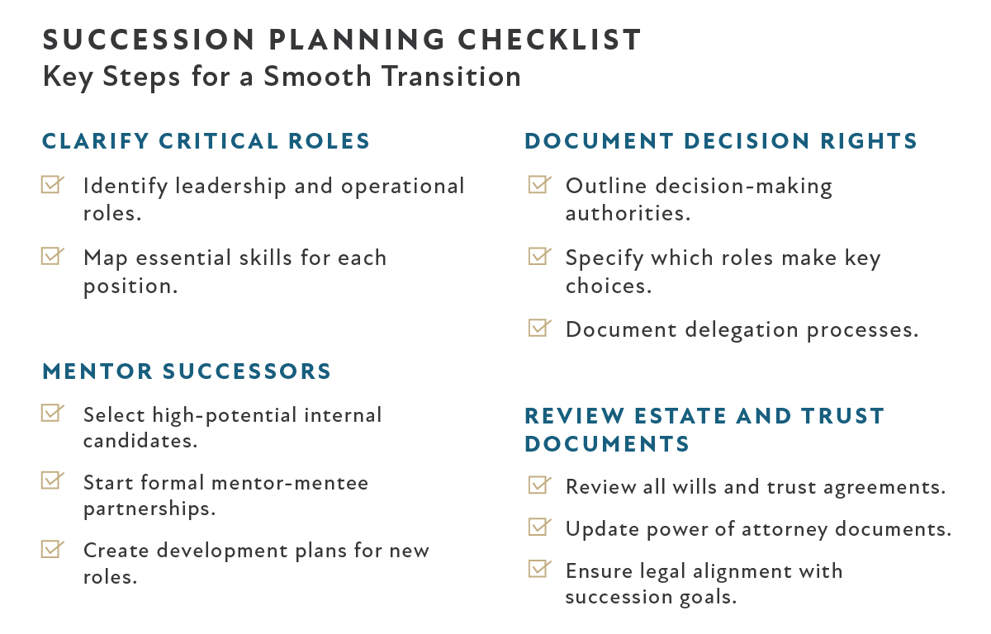
Succession planning adds a future-focused layer, mapping key roles, identifying potential successors and outlining a timeline for transitions to avoid rushed decisions when founders or senior leaders step back. Many families treat succession planning as an ongoing process, revisiting plans periodically as interests, skills and circumstances evolve.
A practical succession planning checklist might include steps such as clarifying critical roles in the family office and family business, mentoring successors, documenting decision rights, reviewing estate and trust documents, and aligning governance with the family’s long-term mission.
FAQs and Common Misconceptions
What are the main benefits of a family office?
A family office centralizes wealth management, governance and administration so that decisions can be made in a coordinated way instead of through disconnected conversations, helping align investments, tax planning, estate planning and family goals. For UHNW families and other families with significant wealth, this level of integration can be essential for sustaining generational wealth and reducing operational strain on individual family members.
Does every wealthy family need a single-family office?
No; many families can achieve their goals through multifamily or virtual family office models that provide comprehensive services with lower cost and operational burden than a fully dedicated single-family office. In some cases, an embedded family office approach within a larger wealth management platform can deliver family office-style coordination for an affluent family without requiring the family to stand up a unique, distinct corporate entity.
When is the right time to formalize a family office structure?
It’s often appropriate to formalize a structure when the sheer number of entities, investments and decision-makers makes ad hoc coordination difficult or when there’s a strategic desire to move from personality-driven decisions to a more durable governance framework. This inflection point often occurs as future generations become more involved and the family’s wealth extends across multiple asset classes, operating businesses and philanthropic initiatives.
How much does it typically cost to run a single-family office?
The cost of running a single-family office generally starts around $1 million per year and can rise into several million dollars annually, depending on the scale of direct services, custom internal staffing and global entity complexity.
How are multifamily office fees commonly structured?
Multifamily office fees may be asset-based, fixed annual, performance-based, hourly or service-based — or a hybrid of these — making it important to understand what’s included and how incentives align. Because fee models vary widely across multifamily office providers, UHNW families should ask how each element of the fee relates to the services and governance oversight being provided.
Next Steps
Understanding family office structures — from single-family and multifamily offices to virtual models — can help you decide how to best organize your wealth, governance and decision-making. The structure you choose should reflect your family’s complexity, values and aspirations, and it should be flexible enough to evolve as your family and assets change.
